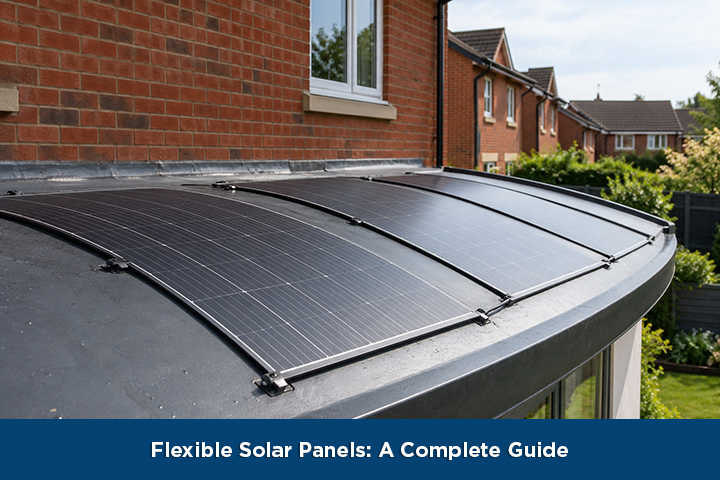

When choosing a solar panel installation at home, a lot of UK homeowners or landlords get a bit mixed up about whether flexible solar panels are right for their property, especially if the roof isn’t totally straight.
Here, we’ll go through all the major things about flexible solar panels. We also put them side by side with rigid solar panels. So you’ll see how lifespan, cost, performance, and the real-world benefits usually compare.
What Are Flexible Solar Panels?
A flexible solar panel is basically a lightweight solar panel built using thin solar cells. The idea is that these panels can bend around gently curved surfaces. Most flexible solar panels use monocrystalline solar or CIGS solar technology, and quite a few products rely on crystalline silicon cells, plus a tough ETFE protection layer.
Some thin-film solar panels use extremely thin layers instead. In practice, these panels still convert sunlight into electricity for everyday use. Many models are set up to work with 12V or “twelve-volt” battery systems, which is why they’re often chosen for off-grid power needs.
You’ll commonly find them on a caravan, motorhome, RV, campervan, or boat. They also make sense for curved roofs, where traditional panels can be tricky to place.
Why Do Homeowners Choose Flexible Solar Panels?
Lots of homeowners prefer a lightweight choice when roof space is awkward. A flexible panel tends to add less weight to the roof, so fitting it can be easier in a bunch of situations. Some systems even use adhesive instead of heavy brackets. A fair number of products come with pre-drilled mounting holes for extra fixing options, which saves time on site.
Flexible solar panels are made for curved surfaces and uneven roofs. They’re usually durable if they’re installed properly. Many models are built to reach an IP68 rating for weather protection. They can still generate power in cloudy weather, though the output is lower. People also pick them for sheds, garages, boats, and garden buildings.
Off-grid solar living is feasible but difficult to achieve in the UK. However, the majority of homeowners opt for hybrid installations to use solar and grid energy. If you want professional advice, contact a solar installer today.
Flexible Solar Panel Types
Monocrystalline Flexible Solar Panels
These are the most popular choices today. A monocrystalline solar panel offers higher efficiency than many other alternatives. In practice, they tend to work better in cloudy conditions too, which makes them a nice option.
Quite a few 400W flexible solar panels use this technology, and that’s why people keep choosing them. Also, many 100W flexible solar panels, along with 200W, 300W and even 500W options, also use it. Because of all that, many buyers see this as the best kind of flexible solar panel overall.
Semi-Flexible Solar Panels
Semi-flexible solar panels are a bit different; they combine strength with flexibility. Usually, they can bend around gentle curves only, not sharp folds, and that matters when you mount them.
Most of the time, many of these semi-flexible models use monocrystalline semi-flexible technology. They’re well suited for campervans, motorhomes, and curved rooftops where a rigid sheet is just not as friendly.
Thin-Film Solar Panels
Thin-film solar panels rely on very thin layers, rather than thick crystalline cells. Many CIGS solar panels fall into this group. They stay extremely light, which is part of the appeal. That said, they usually have lower efficiency than monocrystalline solar panels, so you may need a larger area if you’re chasing the same output.
Flexible Solar Panels vs Rigid Solar Panels
Flexible and rigid panels both produce solar power. However, each option suits different properties.
| Feature | Flexible Solar Panels | Rigid Solar Panels |
|---|---|---|
| Weight | Very lightweight | Heavier aluminium frame |
| Efficiency | Slightly lower efficiency | Higher efficiency |
| Lifespan | 10–15 years | 25–35 years |
| Installation | Easy installation | More complex |
| Roof Type | Curved roofs | Flat or pitched rooftops |
| Durability | Good | Excellent |
| Cost | Usually higher per watt | Better long-term value |
| Best Use | Campervans, boats, sheds | Houses |
Power Output
Flexible panels come in lots of sizes. Common picks are 50W, 100W, 200W, 300W, 400W, and 500W. More wattage typically equals more electricity production, that part is pretty straightforward.
Efficiency
Rigid solar panels normally reach better efficiency. Flexible panels are often less efficient because of their thinner design.
Lifespan
When it comes to lifespan, a flexible solar panel usually lasts about 10 to 20 years. Rigid solar panels often go beyond 25 years. So, it’s more of a trade-off between portability and longevity.
Cost
The price of flexible solar panels depends on size and quality. Smaller models cost much less. Larger systems cost more but generate higher output.
Benefits
Flexible panels are easier to transport. They can fit curved roofs and other curved surfaces without too much stress. They are ideal for boats, caravans, RVs, and motorhomes, especially when space is a little tight.
Disadvantages
- Many people ask about the disadvantages of flexible solar panels.
- Their lower efficiency is one drawback.
- Their lifespan is usually shorter (usually from 10 to 15 years).
- Large home systems may require more roof space.
Typical Flexible Solar Panel Sizes for UK Homes
Based on Bedrooms
| Home Size | Typical System | Estimated Roof Area | Estimated Cost |
|---|---|---|---|
| 1-2 bedrooms | 2-3kW | 12-18m² | £3,000-£4,500 |
| 3-4 bedrooms | 3.5-5kW | 20-30m² | £5,000-£7,000 |
| 5-6 bedrooms | 5-7kW | 30-40m² | £7,000-£9,500 |
Based on Property Type
| Property Type | Typical System | Estimated Roof Area | Estimated Cost |
|---|---|---|---|
| Mid-terrace home | 2-3kW | 12–18m² | £3,000–£4,500 |
| End-terrace or semi-detached home | 3-4.5kW | 18–28m² | £4,500–£6,500 |
| Small detached home | 4-5.5kW | 25–35m² | £6,000–£8,000 |
| Large detached home | 6-8kW | 35–50m² | £8,000–£11,000 |
These figures are typical UK estimates. Final pricing will depend on the roof type, the installer, and the product quality you end up with.
Are Flexible Solar Panels Effective?
Plenty of people ask, Are flexible solar panels effective? Yes, they can be effective for many jobs. They work nicely for off-grid solar setups. They also provide dependable solar charging for batteries, which is often what people care about first.
However, traditional solar panels usually end up giving higher output for most homes. The best choice, I guess, depends on your place and on what you actually consume for energy.
Flexible Solar Panel Installation Procedure
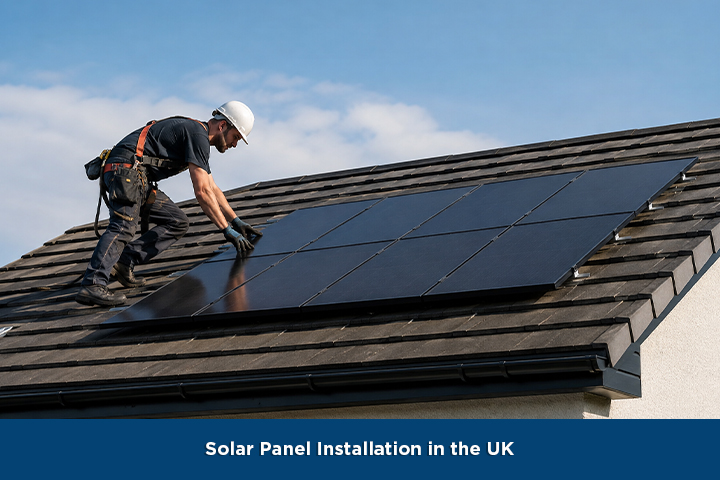
The installation starts with a roof inspection. The installer checks the surface condition. The correct panel size is selected. The surface is cleaned carefully. Panels are fixed using adhesive or mounting hardware.
Some systems include aluminium supports. Electrical cables go into the junction box, then through the system setup. The PV setup connects either to the inverter or to a battery unit.
After testing, everything is confirmed to be safe and operating properly. Only then does the system begin producing renewable energy in a steady way.
Conclusion
Flexible solar panels feel like a great solution for many UK properties. They are light on weight, simple to install, and they sit nicely on curved roofs. They tend to shine for campervans, motorhomes, caravans, and even boats too.
Rigid solar panels still usually win if you want maximum efficiency and longer overall lifespan. At the same time, flexible panels often offer excellent value where weight and bendability matter. So compare performance, flexible solar panels’ price, and the expected lifespan before you decide for good.
Frequently Asked Questions
Are the flexible solar panels any good?
Flexible solar panels can be pretty decent, but mainly for certain mobile or lighter setups like an RV, a van, or even a boat. For home installs, they’re usually not the best choice because they tend to perform worse in real use, and they wear out quicker than rigid panels.
A big issue is that they can hold heat, plus there’s not much airflow underneath, so the whole thing degrades earlier than you’d expect.
What are the disadvantages of flexible solar panels?
With flexible panels, you usually get lower energy output efficiency, something like 10–17% compared with roughly 16–23% for rigid ones. The lifespan is also way shorter, about 10 years for flex (if you’re lucky and conditions are decent) vs. closer to 30 years for the sturdier panels.
On top of that, they’re more heat-sensitive because that airflow gap is basically missing. They also tend to suffer from faster UV aging, and sometimes you see delamination, as the layers start to separate.
How long will a flexible solar panel last?
In practice, a flexible solar panel often lasts around 5 to 10 years if it’s staying full time outdoors, especially in harsh weather. Some higher-end models, with extra protective coatings, can push maybe 10 years.
And in ideal situations, like low-stress mounting and not too much abuse, some can even go as far as 15 years, but yeah, that’s more “best case” than the typical outcome.
Do you need an air gap under flexible solar panels?
Need an air gap to mount flexible solar panels because they are designed to glue or tape flat onto surfaces. However, an air gap is strongly recommended to prevent extreme heat buildup that lowers energy output, degrades the panel prematurely, and transfers intense heat directly into your vehicle or roof.