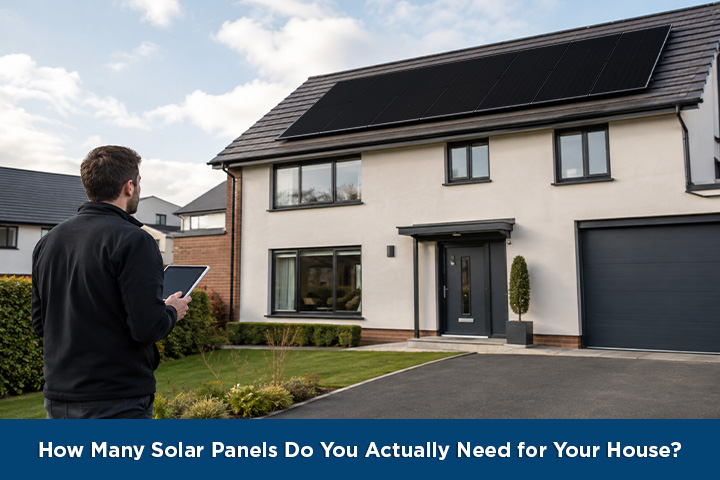

If you’re thinking about going solar, chances are one question keeps coming up: how many solar panels will you actually need to power your home?
There’s no single number that works for every household. It depends on how much electricity you use, where you live in the UK, how much sunlight your roof receives, the size and efficiency of your panels, and how much usable roof space you have.
But you can get a pretty good starting estimate – and once you understand the basic maths, it’s much easier to work out what size solar PV system might be right for your home.
What Actually Changes the Number?
Several factors have a big impact on how many panels you’ll need:
- How much electricity your household uses each year
- Where you live in the UK
- How much sunlight your roof receives
- The efficiency and wattage of your panels
- How much usable roof space you have
- The direction and pitch of your roof
- How much shade the roof receives
- Whether you plan to add an EV, heat pump or other electrical loads
Let’s look at each one.
1. Your Electricity Usage
This is one of the biggest considerations when sizing a solar PV system.
Higher electricity use generally means you’ll need a larger system if you want solar to cover a greater share of your demand.
A small solar array may be able to provide a large percentage of the needs of a small home with moderate electricity use. A larger household with an EV, heat pump, electric heating, or other energy-intensive appliances may need a bigger system to meet its demand.
The figures below give a broad starting point rather than a recommended system size:
| Annual Electricity Usage | Approx. System Size | Approx. Number of 400W Panels |
|---|---|---|
| 2,500 kWh | 2.5–3 kWp | 6–8 |
| 3,000 kWh | 3–4 kWp | 8–10 |
| 4,000 kWh | 4–5 kWp | 10–13 |
| 5,000 kWh | 5–6 kWp | 13–15 |
| 6,000 kWh | 6–7 kWp | 15–18 |
These figures are only a starting point. Your installer should assess your electricity use, roof conditions and expected generation before deciding on the system size.
Also, remember that your solar system doesn’t have to generate the exact same amount of electricity that you use in a year. What matters is how much of your electricity needs the system can meet and how much surplus power you may have available to export.
2. Where You Live in the UK
The more sunlight your panels receive, the more electricity they will generate.
Solar panels will work anywhere in the UK, but the amount of solar power you generate each year will vary depending on where you live in the UK, the weather and the orientation of your roof.
Solar generation generally varies across the UK, with differences in available sunlight affecting annual output. That doesn’t mean solar panels are unsuitable in Scotland, Wales or northern England. Modern solar panels can produce useful amounts of electricity even when it’s not sunny.
Your installer should be able to use local solar irradiation data, roof orientation, pitch and shading to estimate your expected annual generation.
3. Panel Efficiency
Not all solar panels produce the same amount of electricity from the same amount of roof space.
Higher-efficiency panels can produce more electricity from a given area, making them useful where the available installation space is limited.
Choosing higher-efficiency panels can give you:
- More electricity from the same roof area
- A smaller overall roof footprint
- More flexibility when working around skylights, chimneys and other obstructions
- Potentially fewer panels for the same system capacity
The trade-off is that higher-efficiency panels can sometimes cost more.
Where space is restricted, the extra cost of a higher-efficiency panel may be worthwhile if its additional output justifies the price.
4. Panel Wattage
Panel wattage has a direct effect on how many panels you’ll need.
For example, if you’re aiming for an 8 kWp system:
| Panel Wattage | Panels Needed for an 8 kWp System |
|---|---|
| 350W | 23 |
| 400W | 20 |
| 450W | 18 |
The same principle applies to smaller residential systems.
A Real-World Example
Consider a four-person household in the UK using around 4,000 kWh of electricity a year. They have a south-facing roof with little shading, and they decide on 400W solar panels.
A system in the region of 4–5 kWp could be considered, although the final size would depend on the property’s expected solar generation and the household’s objectives.
The ideal system size would be determined by the roof layout of the property, expected solar production, and the household’s goals.
If the family already has an EV or is planning to install a heat pump, the installer may suggest a larger system to accommodate the future demand for electricity.
Claim Your 7,500 Voucher Now
Should You Oversize Your System?
Some homeowners deliberately install a larger solar array than their current electricity usage would suggest.
That can make sense if you expect your electricity consumption to increase.
For example, you might be planning to:
- Buy an electric vehicle
- Install a heat pump
- Add more appliances
- Build an extension
- Increase the number of people living in the property
Installing additional capacity during the initial installation can sometimes be more practical than trying to expand the system later.
However, bigger isn’t automatically better.
Your installer should consider the cost of the additional panels, your expected electricity usage, available roof space, and how much electricity you’re likely to use yourself.
Roof Space vs Panel Count
Here’s a rough indication of how many panels could fit within different amounts of usable roof space:
| Approx. Usable Roof Area | Estimated Number of Panels |
|---|---|
| 15 m² | 7–8 |
| 20 m² | 9–11 |
| 25 m² | 12–14 |
| 30 m² | 14–17 |
| 35 m² | 17–20 |
These figures are only indicative. The shape of the roof, panel dimensions, roof windows, chimneys and required clearances can all reduce the number that will actually fit.
The layout of your roof can be just as important as its total size.
How Much Can You Actually Save?
The amount you can save with solar depends on several factors, including:
- Your system size
- Your annual electricity consumption
- Your electricity tariff
- How much solar electricity you use yourself
- Your home’s location
- Roof orientation and shading
- Whether you have a battery
- The rate you receive for exported electricity
Using solar electricity as it is generated can reduce the amount of power you need to buy from the grid.
A battery can store surplus solar electricity for later use, such as during the evening when your panels are no longer generating power.
Over time, those reductions in grid electricity purchases can add up, but the financial return depends on the system’s cost, generation, household usage and export arrangements.
Mistakes People Make When Sizing a System
A few common mistakes can lead to a system that doesn’t perform as expected:
- Underestimating future electricity usage
- Looking only at the number of panels rather than total system output
- Ignoring roof shading
- Choosing panels based purely on price
- Assuming every roof has the same solar potential
- Installing more panels than the property can economically benefit from
- Choosing an installer based solely on the cheapest quote
A proper solar assessment can help avoid most of these problems.
Getting the Most Out of Your System
Once your solar panels are installed, a few simple steps can help maintain performance:
- Compare the panel warranty, expected performance, and manufacturer’s track record before choosing a system
- Keep the panels reasonably clean and free from heavy debris
- Keep an eye on trees that may eventually cause shading
- Monitor your generation through your inverter or manufacturer’s app
- Use more electricity during daylight hours where practical
- Consider a battery if it makes financial sense for your household
- Have the system checked if you notice an unexpected drop in generation
Solar panels generally require little routine maintenance. Rain can help remove light dirt, although heavier deposits such as bird droppings or accumulated debris may still affect performance. But it’s still worth checking them periodically.
Is More Always Better?
Not necessarily.
The best solar PV system isn’t automatically the one with the most panels. It’s the one that’s properly matched to your electricity consumption, roof characteristics and future plans.
Too few panels may mean you’re still buying a large amount of electricity from the grid.
A larger array also increases the upfront cost, and the additional generation may not provide the same financial return if much of it is exported at a low rate.
That’s why system sizing should be based on more than simply filling every available section of roof.
Bottom Line
So, how many solar panels does your house actually need?
For many UK homes, around 10–16 panels can be a useful starting point, but there is no universal number.
Your ideal system depends on:
- How much electricity you use
- Where you live
- Your roof size
- Roof direction and pitch
- Shading
- Panel wattage and efficiency
- Your future electricity needs
- Whether you want to add a battery or EV charger
The most reliable way to determine the right panel count is to have your property assessed by a qualified solar installer.
A well-sized installation can help you use more renewable electricity at home, reduce grid imports, and make better use of your roof for years to come.
Frequently Asked Questions
How many solar panels does an average house need?
There is no fixed number for an average UK home. Many properties can work well with around 10–16 panels, but the right figure depends on electricity use, panel capacity, roof conditions and expected solar generation.
How do I calculate how many solar panels I need?
Your annual electricity use is a useful starting point, but panel count cannot be worked out from consumption alone. Expected generation depends on your location, roof orientation, pitch, shading and the panels you choose. An installer can use these factors to estimate the output of a proposed system.
Should I install more panels than I currently need?
It can be worth planning for higher future electricity use. If you’re considering an EV, air source heat pump or other electrical upgrades, tell your installer before the system is designed so future demand can be taken into account.
How much can I save with solar panels in the UK?
Your potential savings depend on the installation cost, system output, household electricity use, energy prices, how much solar power you use yourself and the rate available for exported electricity. A battery may also change how much of your generation you can use at home.