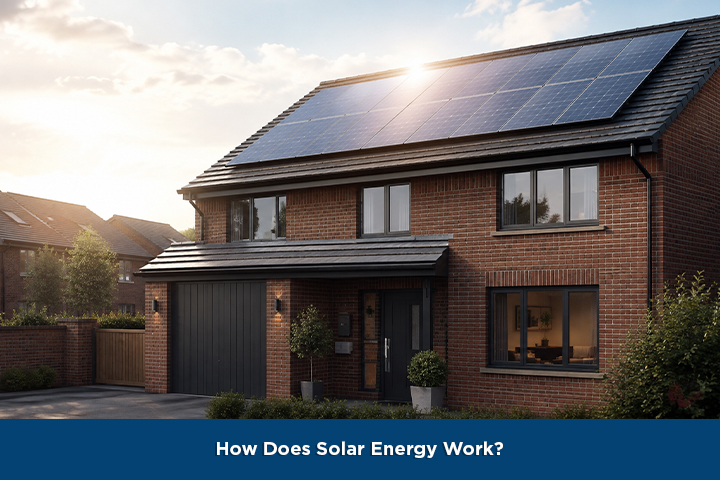

Sunlight hits a panel on a roof, and a few seconds later the kettle downstairs is running on it. That’s the short version. The longer one is more interesting and worth understanding before you spend a few thousand pounds on a system.
This is how solar converts sunlight into electricity for your consumption, what it will realistically be able to power, and how it impacts your bills.
What Are Photovoltaic Panels?
The photovoltaic panel (or PV panel for short) is the large dark rectangular item that you may find bolted onto rooftops or arranged on vast open land areas. “Photovoltaic” refers to the fact that it converts light energy to voltage. It consists of several dozen cells, which are generally thin silicon wafers. The impact of sunlight on the cell releases electrons from silicon and results in the formation of electrical current.
A great number of panels form an array. Small arrays can be found on residential rooftops, while large ones are mounted on warehouses, parking lots and open fields. Utility-scale solar farms are the biggest solar farms in the UK and generate electricity that is then fed straight into the national grid.
The largest solar farm in Kent, called Cleve Hill Solar Farm, was commissioned in 2025 and its capacity is 373 megawatts.
How the Solar Panel System Works Step-by-step
Solar panels do not work alone. An operating system involves moving electricity through several stages:
- Solar panels will be energized by daylight, and the cells will generate DC electricity.
- DC electricity will be converted to AC electricity in the inverter.
- AC electricity will be fed into the consumer unit (fuse box) and will be used to power anything that is connected.
- Any excess energy that is not needed will be stored either in the battery, if there is one, or else sold back to the grid.
- If the panels are generating less than required, whether because of nighttime or cloudy weather, the shortage will be supplied from the grid as usual.
There is no switching to do; the process takes care of itself.
Claim Your 7,500 Voucher Now
Do Solar Panels Work on Cloudy Days?
Yes. It is this question that most homeowners in the UK ask, and the truth of the matter is that photovoltaic panels depend on daylight, not sunlight. Clouds will lower production but not put it to an end. An overcast day can mean your system generates about 10 to 25 percent of its maximum on a sunny day.
This is important because, after all, Britain isn’t known for its sunshine. Yet despite that, solar power has been used to such good effect that 2025 was a record year for solar power, thanks to the fact that it’s been the sunniest 12 months ever recorded by the Met Office since their record began back in 1910. Panels become less efficient when they get hot, so cooler and brighter days suit them just fine.
How Much Electricity Does Solar Provide?
More than most people expect. The solar power system contributed to around 18.3 terawatt-hours of electricity generation in the UK in 2025, which constituted 6.4 percent of the total energy output in the country and set a record share. During sunny afternoons in summer, this figure can double for a while.
The global picture is similar and moving fast. Solar now provides just under 7 percent of the world’s electricity, so close to one unit in every fourteen comes from the sun.
For a single home, a typical domestic system of around 4 kilowatts generates somewhere near 3,400 kilowatt-hours a year in UK conditions. That covers a large slice of an average household’s usage, though how much you personally benefit depends on when you use it.
How Do Solar Panels Work With Your Electric Bill?
This is where solar stops being abstract. Two things happen to your bill.
First, every unit your panels supply is a unit you don’t buy from your supplier. Use your appliances while the sun is up, run the washing machine at midday rather than midnight, and you cut your imported electricity directly.
Second, the surplus you export earns money. Under the Smart Export Guarantee (SEG), licensed suppliers pay you for the electricity you send back to the grid. Rates vary by tariff, so it pays to compare them. Add a home battery, and you can store your daytime surplus for the evening instead of exporting it cheaply and buying it back expensively later.
The combined effect is a lower bill and, for many households, a small payment for the excess. It won’t usually take your bill to zero, because you will still import on dark evenings and through winter, but it changes the maths considerably.
The Advantages of Solar Energy
The advantages of solar energy go beyond the monthly bill:
- Lower running costs, since the fuel is daylight and it’s free once the system is paid off.
- Lower carbon emissions, because solar generates electricity without burning anything.
- More independence from volatile energy prices and grid outages, especially paired with a battery.
- Very little maintenance, with no moving parts and panels that usually carry 25-year performance warranties.
- A possible bump in property value, as buyers increasingly look for homes with lower running costs.
The main trade-off is the upfront cost, plus the fact that output depends on weather and season. For most UK homes with a reasonable roof, the long-term savings still make the case.
Frequently Asked Questions
What is the Lifespan of a Solar Panel?
A panel generally has an expected lifespan of about 25-30 years. It loses a very tiny percentage of its efficiency every year, but even at the end of its lifespan, which will be about 25 years, the panel can function although not as efficiently as before. Inverters are the components that will be replaced within about 10-15 years.
Must I Have a Battery to Make Solar Panels Worth My While?
No, but it affects what you can do with them. Without a battery, you consume energy as it is produced and sell the surplus. With a battery, you save excess solar energy generated during the day for nighttime use, thus increasing the proportion of self-consumed solar energy.
Batteries increase costs, so whether or not they pay off will depend on your consumption habits and tariffs.
Will My Solar Panels Produce Energy in Case of a Blackout?
By default, no. To ensure safety, most grid-tied systems automatically disconnect from the grid in case of a power outage because they cannot operate on their own and risk sending power back into the grid where work is being done by electricians.
Is My Roof Right for Solar Power?
The vast majority of roofs are good for solar. A roof facing south that doesn’t have much shading is best, but roofs facing east and west work just fine too.
The factors that really cut down efficiency are heavy shading by trees or chimneys and an ill-conditioned roof. A trustworthy company will do all of the above-mentioned checks before giving you a quote.