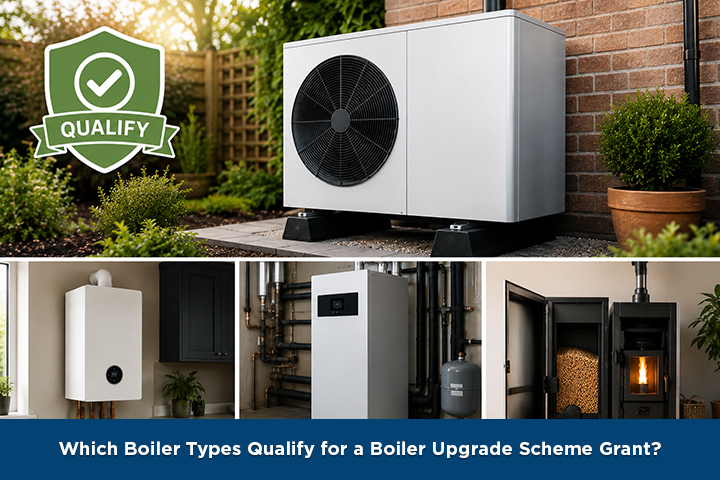

In case your boiler has finally reached its end, and you’ve come across news about grants from the government aimed at assisting with the costs of installing more environmentally-friendly heating solutions, there must be one thing you want to find out. Does the boiler I currently have fit all the requirements?
This question is entirely valid, since according to BUS, one can receive up to £7,500 for the installation of a new heat pump, yet only the applicants who pass the certain criteria are eligible for receiving that money. And the existing boiler system is among the conditions.
So read on to learn more about which types are and which are not eligible, as well as other things you need to consider.
What Is the Boiler Upgrade Scheme?
The Boiler Upgrade Scheme is a UK government grant programme administered by Ofgem. It’s designed to help homeowners move away from fossil fuel heating systems, primarily gas and oil boilers, and towards low-carbon alternatives like heat pumps.
The grant is paid directly to your installer and deducted from your installation cost, so you never see the money change hands. You simply pay less up front.
Current grant amounts (2024–2025):
- Air source heat pump: up to £7,500
- Ground source heat pump: up to £7,500
- Water source heat pump: up to £7,500
- Biomass boiler: up to £5,000 (limited to rural properties off the gas grid)
The scheme runs in phases. Once funding for a phase is allocated, applications close until the next phase opens, so timing your application matters.
Which Boiler Types Qualify for a Replacement Under BUS?
The Boiler Upgrade Scheme isn’t about replacing your old boiler with a newer version of the same thing. It’s specifically for homeowners replacing an existing fossil fuel heating system with a low-carbon alternative.
That means to qualify, your property must currently be heated by one of the following:
Gas Boilers
A standard gas combi boiler, system boiler, or regular (heat-only) boiler connected to the mains gas network all qualify as eligible existing heating systems under BUS.
Gas boilers represent the majority of UK homes, which is exactly why the scheme targets them. Replacing one gas boiler with a heat pump removes a significant source of household carbon emissions.
Oil Boilers
Properties currently heated by oil boilers are also eligible. These are typically found in rural areas where mains gas isn’t available.
Switching an oil system to an air source heat pump is one of the most cost-effective and environmentally impactful moves available to these homeowners, particularly with the grant support available.
LPG Boilers
Homes running on liquefied petroleum gas (LPG) boilers qualify under the scheme. Like oil properties, these are usually in rural or off-grid locations. An LPG boiler replacement qualifies for the full heat pump grant amounts listed above.
Direct Electric Heating (in some cases)
Homes using direct electric heating systems, such as electric storage heaters or panel heaters, may qualify, but this is assessed on a case-by-case basis by the installer and Ofgem.
The property must still meet all other eligibility requirements, and the installer must confirm the system is appropriate.
Biomass Boilers (as a replacement option)
Biomass boilers are listed as an eligible replacement technology, meaning you can receive a grant to install one, but only for properties that are not connected to the mains gas grid.
Urban properties on the gas network cannot use biomass as a qualifying upgrade under BUS.
Claim Your 7,500 Voucher Now
Which Boiler Types Do NOT Qualify?
Understanding the exclusions is just as important as knowing what qualifies. Several scenarios will result in an automatic rejection.
You cannot use the Boiler Upgrade Scheme if:
- Your property already has a heat pump installed. The scheme is for first-time installations, not upgrades to existing low-carbon systems.
- You’re replacing one gas boiler with another gas boiler. The scheme only funds the switch to low-carbon technology, a like-for-like gas replacement does not qualify, regardless of how efficient the new boiler is.
- The property is a new build. New builds are exempt from BUS because they are expected to be built with low-carbon heating from the outset under building regulations.
- The property has an active Social Housing Decarbonisation Fund (SHDF) or ECO4 voucher already in place. You cannot double up on government heat pump funding for the same property.
- The boiler or heating system is in a non-domestic property. BUS is for residential homes only.
Additional Eligibility Conditions Beyond the Boiler Type
Having the right boiler type is a necessary condition for the grant, but it’s not the only one. Your property and installation must also meet the following requirements:
Property must have a valid EPC. Your home needs a current Energy Performance Certificate (EPC) that doesn’t include a recommendation to add loft insulation or cavity wall insulation.
If it does, you’ll need to complete that insulation work before applying, or apply for an exemption if the property genuinely can’t accommodate it (e.g., solid walls).
The installer must be MCS-certified. The Microgeneration Certification Scheme (MCS) is a mandatory accreditation for heat pump and biomass installers under BUS.
Only an MCS-certified installer can apply for the grant voucher on your behalf. You cannot apply directly as a homeowner.
Property must be in England or Wales. Scotland and Northern Ireland operate separate schemes (Home Energy Scotland Grant and Loan and the Boiler Replacement Scheme NI, respectively).
No outstanding BUS voucher on the property. If a previous occupant applied for a BUS voucher that hasn’t been redeemed or has lapsed, this can affect your application. Check the property’s grant history if you’ve recently moved in.
Why Acting Sooner Rather Than Later Makes Sense
The Boiler Upgrade Scheme operates on allocated funding pots per phase. When the funding for a given tranche is claimed, applications pause.
The scheme has seen strong demand, particularly for air source heat pumps, which means there’s a real possibility of funding gaps between phases.
Beyond that, your existing boiler’s age and condition are practical considerations. An ageing oil or gas boiler that fails mid-winter puts you in emergency replacement mode; at that point, accessing BUS funding takes time that you don’t have.
Having your eligibility confirmed and an MCS-certified installer lined up before a breakdown keeps your options open.
The financial case is also shifting. Gas and oil prices remain volatile. A heat pump, once installed, runs on electricity, and with the continued rollout of smart tariffs and off-peak charging rates.
The running cost gap between heat pumps and gas is narrowing. Pairing a heat pump with solar panels accelerates that payback further.
The Bottom Line
The Boiler Upgrade Scheme is one of the most direct financial tools available to UK homeowners who want to move away from gas or oil heating. It doesn’t cover every scenario; new builds, non-domestic properties, and like-for-like gas replacements are all excluded, but for the majority of homes currently on gas, oil, or LPG, the core eligibility bar is achievable.
The process starts with an MCS-certified installer. They confirm your eligibility, handle the voucher application, and deduct the grant from your installation cost. You don’t navigate the scheme alone.
If you’re currently on gas, oil, or LPG and your EPC is in reasonable shape, there’s a good chance you qualify. The only way to know for certain is to get an assessment done.
Frequently Asked Questions
Can I use the Boiler Upgrade Scheme if my boiler is broken?
Yes. The scheme does not require your existing boiler to be operational, only that the property currently uses a qualifying fossil fuel heating system.
If your boiler has broken down, you can still apply, but the installation must be completed by an MCS-certified installer, and all other eligibility requirements must be met before the voucher is issued.
Does my boiler age affect eligibility?
No. The scheme has no requirement around how old your current boiler is. Whether your gas boiler is five years old or twenty, you can still apply to replace it with a qualifying heat pump under BUS. The focus is on the fuel type, not the age of the equipment.
What about combi boilers – would it be possible to change from one to a heat pump?
Yes, indeed. Combi boilers are one of the most frequently used heating sources in British households and therefore fall under the eligibility rules of the Boiler Upgrade Scheme.
The only difference that you need to take into account when choosing between a heat pump and a combi boiler is the method of operation.
Heat pumps heat water more slowly than boilers do and therefore need a hot water cylinder for hot water storage.
Are landlords eligible to apply to the Boiler Upgrade Scheme?
Yes, landlords can apply to the BUS scheme, but only for homes they own as their main home. In some cases, landlords are allowed to make applications for rental properties, but there are some restrictions in place. According to the existing terms of the scheme, this is a grant for owner-occupiers.
What should I do if my EPC recommends insulation?
In case your EPC provides a recommendation about installing either cavity wall or loft insulation, you need to either install such insulation before applying or show that this is not possible for technical reasons and apply for an exception via Ofgem.