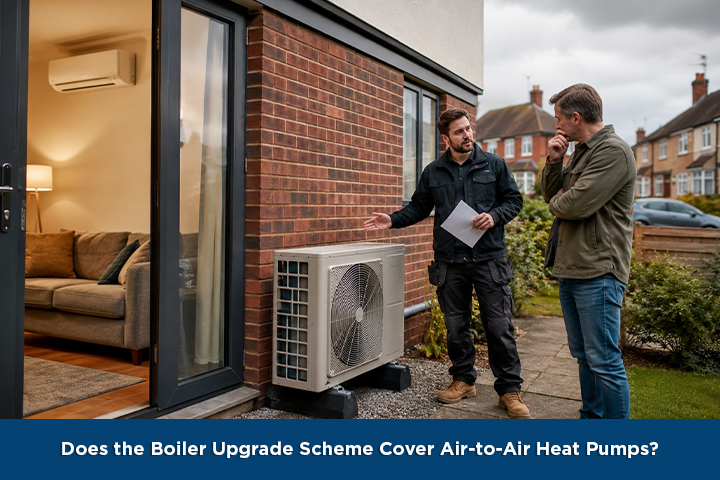

The air-to-air heat pump is rare in the United Kingdom, as people prefer the air-to-water solution that works with radiators and underfloor heating.
However, air-to-air heat pumps have several attractive benefits. They cost much less than air-to-water systems. Installation is usually quicker and simpler. They also provide both heating and cooling from one unit.
So, most homeowners consider it unappealing because it can hardly be a cheap upgrade option. The most frequent question is the following: Are air-to-air heat pumps funded through BUS?
Answer: No. Air-to-air heat pumps aren’t eligible for funding under the Boiler Upgrade Scheme. In this guide, we explain why. We also explore available alternatives and funding options.
What Is the Boiler Upgrade Scheme?
The Boiler Upgrade Scheme is a government initiative aimed at helping households switch to low-carbon heating solutions to reduce carbon emissions in the UK.
It also supports the UK’s journey towards net zero. Eligible homeowners can receive financial support towards installation costs. The grant is paid directly to approved installers.
This reduces the upfront cost for homeowners. The scheme currently offers:
Heating System Grant Amount Air Source Heat Pump £7,500 Ground Source Heat Pump £7,500 Biomass Boiler £5,000.
This scheme covers installations in England and Wales. They should be carried out by certified contractors who have MCS certification.
What Is an Air-to-Air Heat Pump?
Air-to-air heat pumps transfer heat from the outdoor air into a dwelling. Such heat pumps work similarly to air conditioners. Inside units installed on the walls/ceilings blow warm air indoors in winter.
During summer months, the process is reversed, and air-to-air heat pumps cool the interior. Unlike air-to-water devices, they don’t supply hot water.
They cannot supply hot water for taps or showers. They also do not connect to traditional radiators. Instead, they directly heat indoor air.
Claim Your 7,500 Voucher Now
Does the Boiler Upgrade Scheme Cover Air-to-Air Heat Pumps?
No. Air-to-air heat pumps don’t qualify for the BUS program and don’t provide eligibility for £7,500. It doesn’t matter how energy-efficient they get; there will be no changes in qualification status.
Reason: Such devices heat and cool spaces but are not able to heat water needed for daily household purposes, which is essential for the scheme to operate. The government focuses on systems that replace both heating and hot water production.
Why Are Air-to-Water Heat Pumps Supported Instead?
In contrast, the air-to-water systems can both heat and cool premises and provide a hot water supply.
Thus, they can replace gas boilers, which fits into the government agenda of switching to renewable energy sources and minimising the consumption of fossil fuels. Therefore, air-to-water pumps receive funding under the BUS scheme.
Are Air-to-Air Heat Pumps Still Worth Considering?
Absolutely. There are some pros of this system, including its main advantage, which is affordable prices. Purchase and installation costs are usually lower. Many installations require less disruption. There is often no need for new pipework.
Radiator upgrades are usually unnecessary. Installation can often be completed quickly. Another major advantage is cooling. Traditional boilers cannot cool homes during hot weather. Air-to-air systems provide heating and cooling from one unit.
This can improve year-round comfort. They are also highly energy-efficient. Modern systems can produce several units of heat from one unit of electricity. This helps reduce energy consumption.
How Much Does an Air-to-Air Heat Pump Cost?
Costs vary depending on property size. It depends on the number of indoor units required. In general, the cost of installation starts from £2,500 up to £8,000 in the UK. Houses with a smaller square footage require less money. Larger homes often require multiple indoor units.
This increases installation costs. Despite the lack of government funding, people still view this solution as affordable. Affordable installation fees might be beneficial when comparing them with other large renewable heating systems.
Can You Get Any Funding for Air-to-Air Heat Pumps?
Unfortunately, the BUS program is not available to those who plan to install this heat pump. Funding options are rather narrow, for instance, sometimes local councils launch energy efficiency programs. Support levels also change over time.
Homeowners should check local council schemes regularly. Some wider energy improvement programmes may include heating upgrades. Eligibility conditions for participation vary significantly, so there is no guarantee. Check all the rules prior to applying.
Should You Choose an Air-to-Air or Air-to-Water Heat Pump?
The right choice depends on your property and goals. An air-to-water heat pump may suit you if:
- You want Boiler Upgrade Scheme funding.
- You need hot water production.
- You have radiators or underfloor heating.
- You want a full boiler replacement.
An air-to-air heat pump may suit you if:
- You want lower installation costs.
- You need heating and cooling.
- You want quicker installation.
- You do not require hot water production.
- You want a simple heating solution.
These systems are equally green. Only specific conditions affect your decision regarding choosing one.
Final Thoughts
Air-to-air heat pumps are highly efficient and inexpensive yet versatile and easy to install. However, such devices are ineligible for the BUS grant program.
The scheme only supports technologies that provide heating and hot water. Note that air source heat pumps, ground source heat pumps, and biomass boilers aren’t covered either. Thus, if you are interested in getting the £7,500 grant, you should probably choose air-to-water heat pumps.
If you seek an affordable system with the cooling option, then go for air-to-air.
Frequently Asked Questions
Does This System Provide Your Heating Needs?
An air-to-air system heats the space effectively, but can’t provide a hot water supply. So, most of us opt for installing a hot water tank separately.
Do air-to-air heat pumps work during cold UK winters?
Yes. Modern systems are designed to work in low temperatures. Most continue operating efficiently during typical UK winter conditions. This option performs slightly worse in extreme cold weather, but still heats up the place.
Do air-to-air heat pumps require radiators?
There are no radiators in this case as the air-to-air system provides hot air through units installed on the wall.
Are air-to-air heat pumps cheaper to run than electric heaters?
Yes, they are more energy-efficient and produce more energy than they consume. Thus, they can reduce your heating expenses as compared with electric radiators.
Can you combine an air-to-air heat pump with solar panels?
Yes, many people use air-to-air heat pumps with solar panels generating electricity.