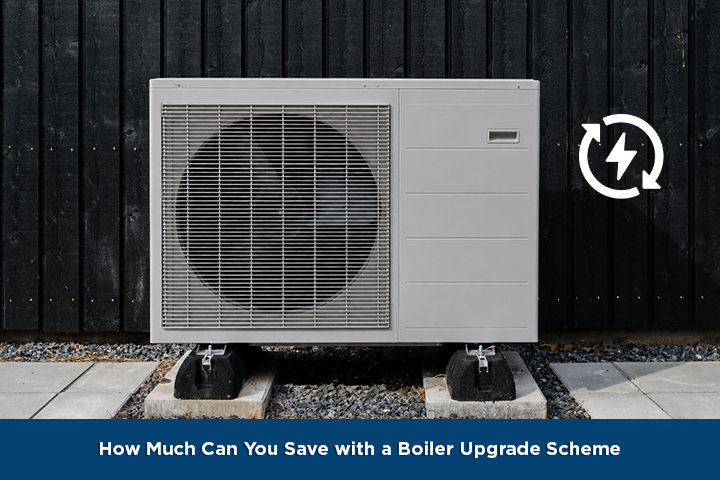

Eventually, that depends on the system you are replacing your current boiler or any heating system with. The Boiler Upgrade Scheme offers three ranges of funds. The funding ranges from £5,000 to £75,000, and surprisingly, some new developments indicate an increase in the amount.
Let’s find out in this guide what expenses are covered by this scheme, what sort of savings you can make from it, and whether you should apply. Also, an additional £2,500 of funding is available.
What Is the Boiler Upgrade Scheme?
The Boiler Upgrade Scheme is a government-funded grant for homeowners to subsidise the replacement of fossil fuel heating systems with low-carbon heat pumps.
Here are the current grant amounts:
- For air source heat pumps: £7,500
- For ground source heat pumps (including water source heat pumps): £7,500
- For biomass boilers (only available in rural locations without gas connections): £5,000
The good news is that this is not a loan, so you do not have to repay the amount received. The installer gets the money from the government and then discounts the price from the beginning.
How Much Does a Heat Pump Actually Cost?
Here comes the surprise! Heat pumps don’t come cheaply. An average air source heat pump will cost you somewhere between £8,000 and £15,000. The price range depends on the size of your house, its insulation level, and the necessary additional installations such as radiator replacement and underfloor heating.
After the £7,500 grant has been deducted, you will have to pay between £500 and £7,500 for an air source heat pump installation. For a majority of houses, especially those with decent insulation, the former is more likely.
A ground source heat pump is more expensive at first, costing anywhere from £15,000 to £30,000, but after deducting the £7,500 grant, the initial expense is significantly reduced. However, the running costs are relatively cheaper than in air source heat pumps.
Claim Your 7,500 Voucher Now
Are There Any Other Operating Costs That May Be Saved?
And the answer is: Yes and No.
The thing is that, depending on your present heating appliance and its condition, you’ll need to take into account various factors: current electricity costs, the degree of insulation of your house, and the system design and installation, which also plays an important role.
According to Energy Saving Trust estimations, replacing an old oil or LPG boiler with a heat pump may help you save up to £1,400 and £500 a year in heating costs.
But if you install a heat pump instead of a gas boiler, the difference in your electricity costs will be much smaller.
In this case, it is better to keep in mind that heat pumps are relatively simple in structure and require little maintenance; besides, their lifetime often exceeds 20 years.
Who Qualifies?
To be eligible for the Boiler Upgrade Scheme:
- Your property must be in England or Wales
- It must have a valid Energy Performance Certificate (EPC) with no outstanding recommendations for loft or cavity wall insulation (you need to address those first, or have a good reason why they can’t be done)
- The installer must be MCS-certified and registered for the scheme
- The property can be a home, a small business, or a non-domestic building, though most applicants are homeowners
You can only claim one grant per property. Landlords can apply for rental properties, and self-builders can apply too.
One thing worth knowing: there’s no income threshold. The scheme isn’t means-tested, so it’s open to anyone who meets the property and installation criteria.
Is It Worth It for Your Home?
The scheme works best if:
- You’re already planning to replace an ageing heating system
- Your home has decent insulation (or you’re willing to improve it)
- You’re not connected to the gas grid; in that case, the savings on running costs are more substantial
- You’re thinking long-term rather than looking for an immediate payback
For a draughty Victorian terrace with single glazing and no loft insulation, a heat pump might not perform well regardless of the grant. For a well-insulated semi-detached or a newer build, it’s a genuinely practical option.
The best starting point is getting a proper survey done by an MCS-certified installer. They’ll assess your home, give you realistic figures, and handle the grant application; it doesn’t come out of your pocket at any point.
The Bottom Line
If you’re weighing up whether this makes sense for your property, get in touch. We’re MCS-certified, and we handle the grant paperwork.
And we’ll tell you honestly if a heat pump isn’t going to work well in your home, because fitting the wrong system doesn’t do anyone any favours.
Frequently Asked Questions
Can I apply for the Boiler Upgrade Scheme myself, or does my installer do it?
Your installer handles the application. They claim the grant directly from Ofgem and pass the savings on to you as a reduction in your installation cost. You don’t need to submit any forms or wait for a payment; it’s deducted before you pay.
Does my home need to be fully insulated before I can apply?
Not necessarily fully insulated, but your EPC must not show any outstanding recommendations for cavity wall or loft insulation that can be installed.
If your property can’t have those done, for example, if you have solid walls or your loft is already at capacity, your installer can still proceed, but they’ll need to document why the insulation isn’t feasible.
How long does the grant last? Is there a deadline?
The Boiler Upgrade Scheme is currently funded through to March 2028. Grant vouchers are valid for three months once issued, so once your installer applies, you have time to complete the installation without rushing.
Can I get the grant on a second home or a rental property?
Yes. The scheme covers domestic properties, including holiday homes and rental properties, in England and Wales. Each eligible property can receive one grant, regardless of who owns it.
What happens if my heat pump installation costs less than the grant amount?
The grant covers up to the actual cost of the installation; it won’t pay out more than what the system costs.
In practice, heat pump installations almost always exceed the grant amounts, so this rarely comes up. But if it did, you’d simply pay nothing, and the installer would claim the reduced amount.