
Solar panels are often sold as fit-and-forget, and mechanically that’s mostly true: no moving parts, no fluids, nothing to service in the way a boiler needs servicing. But the surface of the panel and the electronics behind it are a different story.
A bit of grime cuts into output quietly, and an ageing inverter can fail without much warning. Maintenance of a solar panel system is important and will help preserve the initial outlay of money without demanding much time and money, and this article discusses how the maintenance process should be carried out in a typical UK household.
Do Solar Panels Actually Become Less Efficient When Dirty?
Yes, although rainwater washes away most dirt in the UK better than people think. As per the figures given by the Energy Saving Trust and Solar Energy UK, the average soiling reduces efficiency by 2-5% throughout most of England, Wales, and Scotland, reaching 7% or higher in more industrialized urban environments or close to intensive farming.
While rainwater washes away loose dirt quite effectively, it has little impact on bird droppings, tree sap, pollen, or moss, which accumulate no matter what the weather is.
The loss is easy to miss because it happens gradually rather than all at once. A panel generating 5% less than it should won’t look obviously dirty from the ground, but over a 25-year system lifespan, that gap adds up to a real amount of lost generation and export income.
How to Clean Solar Panels?
If your panels have been mounted on a one-story roof or elsewhere where they are easily accessible from the ground level, the process of cleaning them yourself is not complicated.
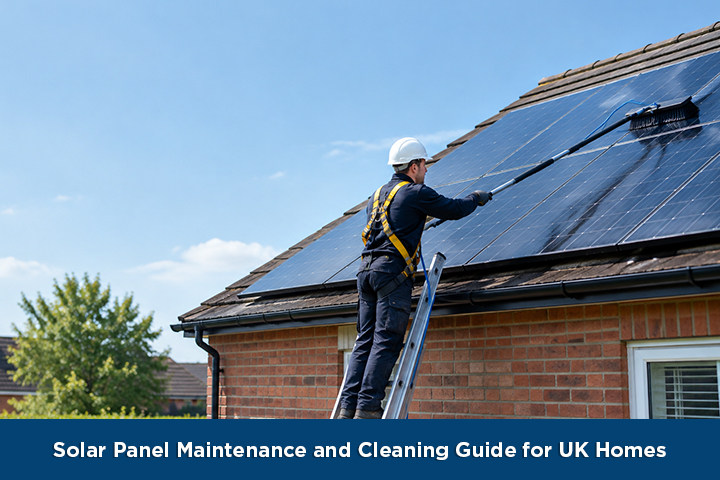
The safest method to wash solar panels that won’t damage them or compromise your warranty is to use a brush or a sponge, a telescopic water-fed pole, and deionized water as opposed to tap water, because it leaves mineral stains when it dries up.
Do not use detergent. Most companies advise against it because soap leaves behind a film that attracts more grime over time, while the improper use of chemicals may even invalidate your warranty completely. Do not step on the roof panels at any point in time, and do not use high-pressure washing, since the water can get inside the seals.
If you have a steep roof or one that is multi-storeyed, or if you need to follow certain warranty conditions, then the cleaning has to be done by a professional cleaner and not through a ladder. In almost all cases, professional cleaners make use of water-fed poles to wash the roofs.
Off-grid solar living is feasible but difficult to achieve in the UK. However, the majority of homeowners opt for hybrid installations to use solar and grid energy. If you want professional advice, contact a solar installer today.
How to Clean Solar Panels on a Roof Automatically?
For larger arrays, ground-mounted systems, or anyone who’d rather not think about it, automated cleaning exists. Robotic units use a rotating brush or squeegee to work across each row of panels, some running on a fixed schedule and some triggered by a soiling sensor, and a handful of systems use periodic water sprays instead of a physical brush.
These make more financial sense for solar farms, warehouses, and commercial rooftops, where the sheer number of panels makes a recurring manual clean expensive. For a typical UK home with 10 to 16 panels, the upfront cost of a robotic system rarely pays for itself against an annual professional clean costing £80 to £200.
It’s worth considering only if your roof is genuinely difficult to access, your array is unusually large for a domestic property, or a professional clean simply isn’t practical where you live.
Solar Panel Maintenance Checklist
A working routine for most UK homes looks something like this:
- Check the monthly readings through the monitoring software or the inverter display, comparing them to the same period in the previous year, because any quick or gradual reduction in the measurement can point to a problem.
- Inspect the solar panels every couple of months from the ground level to see any cracked glass, loose mounting, nesting of animals underneath, or newly added shade due to a tree or extension.
- Cleaning of the panels is done at least once a year, but it may be necessary twice a year if the panels are installed near the sea, trees, farmland, or busy roads where the formation of traffic film is quick.
- Annual professional inspection of the inverter, wires, isolators, and mountings should be scheduled because they are prone to failure.
- The gutter cleaning of nearby parts of the roof before the autumn season should be considered because heavy rains can carry leaves and debris onto the panels.
How Often Should Solar Panels Be Serviced?
Manufacturers and installers certified by MCS tend to suggest a complete service at least once a year for the electrical part of the solar system, not just the panels themselves: inverter servicing, DC and AC connections, isolator operation, and proper mounting.
However, installers can take up to 18 or 24 months, depending on whether it is an uncomplicated system without any underperformance indicators in the app, while one year is preferred as being a safer option.
Cleaning runs on a separate, more flexible schedule. Once a year suits most homes, twice a year suits homes with heavier soiling exposure, and skipping a year rarely causes lasting harm given how much UK rain contributes on its own.
Either way, anything involving the DC wiring or the inverter internals is a job for a qualified engineer. Solar circuits stay live even when the system is switched off at the isolator, so this isn’t an area for a confident guess.
Solar Panel Maintenance and Cleaning Cost in the UK
Professionally, it will cost between £4 and £15 per panel or between £80 and £200 for all panels in one session, depending on the height of your roof and the number of panels you have. The DIY kit that you purchase once will pay for itself after one professional session and will cost you £40 to £120.
An electrical check, which entails an inspection of the inverter and wiring as opposed to cleaning the glass, can also cost between £80 and £200, and some companies provide a combined service at a slight reduction in cost.
It is prudent to budget between £100 and £300 annually for maintenance and cleaning of the solar panel in view of its cost and the years that it will serve.
Commercial Solar Panel Cleaning
Commercial solar panel cleaning works on a different scale and usually has a different contract structure. Instead of pricing per panel, larger sites are typically quoted per kilowatt, often £2 to £4 per kW per year as part of a bundled operations and maintenance contract that includes both cleaning and inspection visits.
Access tends to involve cherry pickers, podium steps, or drone-based inspection rather than a pole from the ground, and health and safety requirements around working at height are considerably stricter given the scale involved.
Frequency is usually annual at minimum, moving to twice a year for larger installations or sites in heavily polluted, coastal, or agricultural areas, where soiling builds up faster, and the revenue at stake from lost generation is much higher than on a typical home.
Frequently Asked Questions
What's the Best Way to Clean Solar Panels at Home?
A soft brush or sponge with deionised water, applied from a safe, ground-level position, works better than tap water or any detergent, both of which can leave residue or damage the coating.
Can I Clean My Solar Panels Myself?
Yes, if they’re safely reachable from the ground or with a telescopic pole. Steep roofs, multi-storey installs, or warranty terms that require professional servicing are better left to a trained cleaner.
Do Dirty Solar Panels Really Lose Efficiency?
Yes. Typical UK soiling reduces output by roughly 2% to 10% depending on location, and it happens gradually enough that most homeowners only notice it by checking their monitoring data.
None of this requires much time. A yearly clean, an annual electrical check, and the occasional glance at the monitoring app cover almost everything a UK solar system needs. What matters is doing it consistently rather than perfectly, since a simple solar panel maintenance and cleaning habit, kept up year after year, is what actually protects the output and the payback period you were promised at installation.
What Kind Of Maintenance Is Required On Solar Panels?
Solar panels need very little maintenance. Keep an eye out for leaves, dirt, and bird droppings, particularly if there are trees close to your roof. Checking the system’s electricity generation now and then is also useful. A sudden drop in output may mean there is a problem that needs checking.
Does Rain Clean Solar Panels?
Rain can wash away loose dust, but it will not remove everything. Bird droppings, leaves, and stubborn marks can remain on the panels. Check them occasionally and arrange cleaning when there is enough dirt to affect how well they work.